





A portable power station can run an outdoor projector, making it possible to enjoy movie nights without access to traditional electrical outlets. Most projectors consume manageable amounts of electricity, but battery runtime depends on projector wattage, power station capacity, and connected accessories. Speakers, streaming devices, and lighting can increase overall energy consumption. Choosing compatible equipment and calculating power requirements beforehand helps prevent interruptions. This guide explains how to estimate projector runtime, select an appropriate power station, and set up an efficient outdoor entertainment system.
Table of Contents
How Much Power Does an Outdoor Projector Need?
Understand the Wattage Requirements of Different Projector Types
Outdoor projectors have different electricity requirements depending on their technology, brightness, and size. Compact LED projectors may consume approximately 30–100 watts, while larger home theater models often require 150–350 watts or more. Laser projectors can also draw substantial power, particularly at higher brightness settings. Check the manufacturer’s rated power consumption rather than relying solely on brightness specifications. Understanding these differences helps you estimate energy requirements and choose a suitable portable power source.
Check Power Needs for Speakers, Streaming Devices, and Accessories
An outdoor movie setup often includes additional equipment beyond the projector. Portable speakers may consume 10–50 watts, while streaming devices typically require around 2–15 watts. Decorative lighting, wireless routers, and device chargers add further electrical demand. Check each accessory’s rated wattage and identify whether it uses AC, USB, or DC power. Add the consumption of devices operating simultaneously to determine the total load your portable power station must support during the movie.
Match Projector Power Requirements With Power Station Output
Choose a power station with continuous AC output exceeding the combined wattage of your projector and accessories. Check startup demands and confirm that the unit supports your equipment’s voltage requirements. For example, the Anker SOLIX C2000 Gen 2 provides 2,400W of rated output and up to 4,000W peak power for compatible appliances. This offers substantial output capacity for outdoor entertainment setups, although battery capacity ultimately determines how long the equipment can operate.
How Long Can a Portable Power Station Run an Outdoor Projector?
Calculate Projector Runtime Based on Battery Capacity
Estimate projector runtime by dividing the power station’s usable battery energy in watt-hours (Wh) by the projector’s wattage. For example, a 500Wh battery powering a 100W projector provides a theoretical runtime of five hours. Actual operation will be shorter because energy conversion consumes additional power. A practical estimate should include these losses and any battery capacity limitations. Calculate runtime before your event to confirm that the available energy covers the entire movie.
Account for Inverter Efficiency and Additional Device Consumption
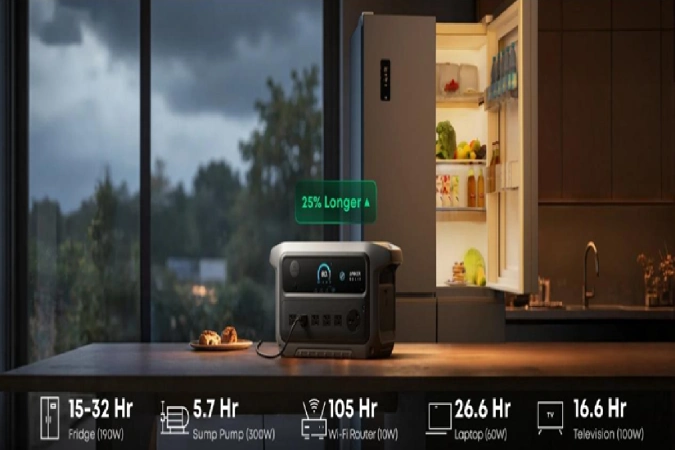
Portable power stations use inverters to convert stored battery energy into AC electricity, creating some energy loss. For planning purposes, an assumed inverter efficiency of 85–90% provides a useful starting estimate. A 100W projector and 30W speaker create a combined 130W load. With a 500Wh battery and 85% efficiency, estimated runtime is approximately 3.3 hours. Actual runtime also reflects standby consumption, battery condition, operating temperature, and the power requirements of connected accessories.
Estimate Battery Needs for a Two- to Four-Hour Outdoor Movie Night
For a typical outdoor movie setup, estimate the combined power draw before selecting battery capacity. A 150W projector, 30W speaker, and 10W streaming device consume approximately 190W together. Over two hours, they require 380Wh of AC energy; four hours require 760 Wh. Assuming 85% conversion efficiency, plan for roughly 450Wh to 900Wh of battery capacity. Adding a reserve provides flexibility for longer movies, additional accessories, and unexpected energy consumption.
How to Set Up a Portable Power Station for Outdoor Movie Nights
Choose a Safe, Dry Location for Your Power Station and Projector
Position the power station on a level, dry surface away from sprinklers, puddles, and areas exposed to rainfall. Keep it close enough to the projector to avoid unnecessary cable lengths while maintaining adequate ventilation. Place the projector on a stable stand with an unobstructed view of the screen. Protect both devices from direct moisture and excessive heat. Arrange the setup away from busy walkways to reduce accidental impacts and tripping hazards.
Connect Your Projector, Speakers, and Streaming Devices Safely
Before connecting equipment, switch off the projector and confirm that all cables and connectors are undamaged. Plug the projector into a compatible AC outlet and connect speakers or streaming devices through suitable ports. Avoid exceeding the station’s continuous output rating when operating multiple appliances. Use properly rated extension cords only when necessary, and keep connections away from moisture. After powering everything on, monitor total wattage and confirm that each device functions correctly.
Extend Battery Runtime With Power-Saving Settings and Smart Charging
Lower projector brightness when ambient lighting permits, since reduced brightness can decrease electricity consumption on many models. Enable available eco modes and switch off unused accessories during playback. Fully charge the power station before leaving home to maximize available battery energy. If supported, use compatible solar panels to replenish power during daylight hours before the movie begins. Monitor remaining battery capacity throughout the event and reduce unnecessary loads to preserve runtime.
Conclusion
A portable power station can successfully operate an outdoor projector when its output capacity and stored energy match the entertainment setup’s requirements. Calculate the combined wattage of your projector, speakers, and accessories, then estimate runtime using battery capacity and conversion efficiency. Proper equipment placement, safe electrical connections, and energy-saving settings further improve reliability. By preparing your power supply in advance, you can enjoy uninterrupted outdoor movie nights at campsites, backyard gatherings, and other locations without convenient electrical access.