





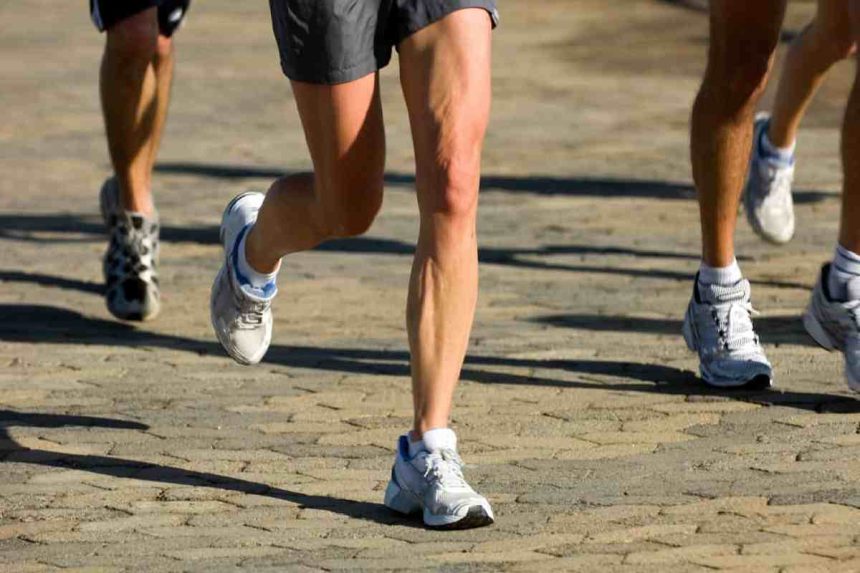
Health Benefits of Running Shoes. Proper running shoes are one of your most important investments in long-term health and injury prevention. Every mile you run subjects your body to repetitive impact forces—up to three times your body weight with each foot strike. Without adequate protection and support, these forces can lead to chronic injuries, joint deterioration, and shortened running careers.
But the right running shoes do far more than just cushion impact. They improve biomechanics, enhance performance, reduce fatigue, and enable you to run consistently without pain—which unlocks the full cardiovascular, mental health, and longevity benefits of running.
Whether you’re a beginner lacing up for your first 5K or an experienced marathoner logging high weekly mileage, understanding the health benefits of running shoes will help you make smarter choices, stay injury-free, and enjoy running for years to come.
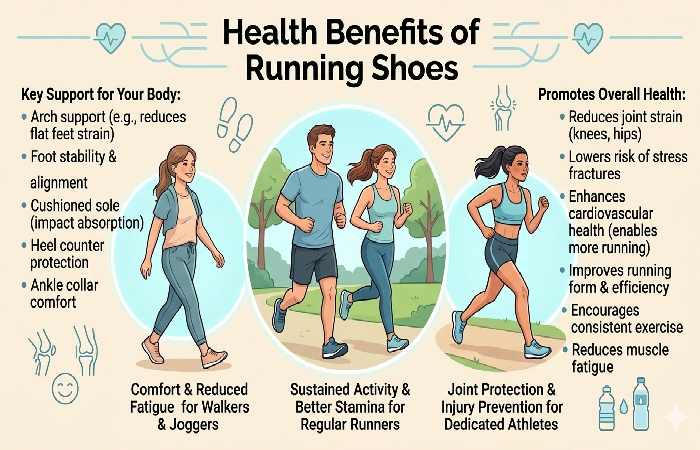
Table of Contents
Why Running Shoes Matter for Your Health
The Impact of Running on the Body
Running delivers extraordinary health benefits: it strengthens your heart, builds bone density, improves mental health, and increases longevity. Studies show that running for just 50 minutes per week at a moderate pace can lower your risk of heart disease.
But running is also a high-impact activity. Each step generates force that travels through your feet, ankles, knees, hips, and spine. Over the course of a 6-mile run at a 180-step-per-minute cadence, you’ll take approximately 10,800 steps. That’s 10,800 opportunities for force to stress your musculoskeletal system.
How Running Shoes Serve as Your First Line of Defense
Running shoes are engineered to manage and disperse impact forces that would otherwise damage your body. They accomplish this through:
- Shock-absorbing midsoles that reduce peak impact forces
- Supportive structures that maintain foot and ankle alignment
- Cushioning systems that protect joints from repetitive stress
- Biomechanical design that encourages efficient, healthy running form
Without proper running shoes, even short runs can lead to painful injuries that derail your fitness goals and require weeks or months of recovery.
Top Health Benefits of Wearing Proper Running Shoes
1. Injury Prevention: Protecting Against Common Running Injuries
The single most important benefit of running shoes is injury prevention.
Running-related injuries (RRIs) are extremely common, affecting up to 79% of runners at some point. The most frequent injuries include:
- Plantar fasciitis (heel and arch pain)
- Shin splints (medial tibial stress syndrome)
- Achilles tendonitis
- Patellofemoral pain syndrome (runner’s knee)
- IT band syndrome
- Stress fractures
Proper running shoes reduce injury risk by:
- Absorbing shock before it reaches vulnerable tissues
- Maintaining proper foot alignment throughout the gait cycle
- Providing stability to prevent excessive pronation or supination
- Cushioning high-impact areas (heels, forefoot, arches)
- Supporting the natural biomechanics of running motion
While research shows that no single shoe type eliminates all injury risk, proper footwear matched to your individual biomechanics significantly reduces the likelihood of common running injuries.
2. Joint Protection: Reducing Impact on Knees, Ankles, and Hips
Your joints absorb tremendous force during running. Without adequate cushioning and support, this repetitive impact can lead to:
- Cartilage wear and early-onset osteoarthritis
- Chronic knee pain
- Ankle instability and sprains
- Hip misalignment and bursitis
Running shoes protect joints through:
- Midsole cushioning that reduces peak ground reaction forces
- Impact dispersion that spreads force across a broader area
- Heel counters that stabilize the ankle and prevent rolling
- Proper alignment that ensures joints move through natural ranges of motion
Research published in Medicine & Science in Sports & Exercise found that highly cushioned shoes reduce impact loading rates and improve running economy, meaning your body experiences less stress while maintaining performance.
3. Improved Biomechanics and Foot Alignment
Proper running shoes guide your feet through healthy movement patterns.
Different arch types (flat, neutral, high) require different support structures:
| Arch Type | Common Issue | Recommended Shoe Feature |
| Flat Feet / Low Arches | Overpronation (foot rolls inward excessively) | Stability shoes with medial post support |
| Neutral Arches | Generally balanced mechanics | Neutral cushioned shoes |
| High Arches | Underpronation/supination (foot rolls outward) | Cushioned shoes with flexibility |
When shoes match your biomechanics:
- Your ankles remain stable through each stride
- Your arches are supported without being restricted
- Your feet maintain proper alignment with your legs and hips
- Force is distributed evenly across your foot structure
A podiatrist or running specialty store can perform gait analysis to determine your specific biomechanical needs and recommend appropriate footwear.
4. Enhanced Running Performance and Economy
Proper shoes don’t just prevent injuries—they help you run better.
Research demonstrates that highly cushioned shoes improve running economy by reducing oxygen cost (Oc) during exercise. This means:
- Your muscles require less energy to maintain the same pace
- You can run longer distances before fatigue sets in
- Your body experiences less metabolic stress
Additionally, studies show that cushioned running shoes:
- Improve time to exhaustion during incremental treadmill tests
- Maintain performance benefits even when muscles are damaged from intense training
- Enhance peak running speed attained during maximal effort
Better performance equals healthier training: When you run more efficiently, you place less cumulative stress on your cardiovascular and musculoskeletal systems.
5. Better Posture and Spinal Health
Your feet are the foundation of your entire kinetic chain.
Poor footwear choices create a domino effect:
- Collapsed arches → ankle instability → knee misalignment → hip dysfunction → lower back pain
Proper running shoes maintain structural alignment from the ground up:
- Support arches to prevent collapse and inward rolling
- Stabilize ankles to ensure proper leg tracking
- Encourage neutral posture that minimizes spinal stress
- Reduce compensatory movements that strain the back and hips
Over time, running in shoes that support healthy alignment can reduce chronic back pain and improve overall posture—even outside of running.
6. Reduced Fatigue and Faster Recovery
The right shoes help your body recover faster between runs.
When shoes provide adequate cushioning and support:
- Muscles experience less eccentric stress (the type that causes damage)
- Joints absorb less repetitive microtrauma
- Soft tissues (tendons, ligaments, fascia) are protected from overload
Shoe rotation amplifies this benefit. Alternating between multiple pairs of running shoes:
- Varies the stress patterns on your muscles and joints
- Prevents overuse of specific structures
- Allows shoes to fully decompress between runs (midsole foam needs 24-48 hours to recover)
Runners who rotate shoes report fewer overuse injuries and better training consistency.
7. Long-Term Musculoskeletal Health
Investing in proper running shoes protects your body for decades.
By preventing injuries and protecting joints throughout your running career, quality footwear:
- Reduces risk of early-onset osteoarthritis in weight-bearing joints
- Maintains bone density by enabling consistent, safe impact exercise
- Prevents chronic conditions like plantar fasciitis that can become lifelong issues
- Supports active aging by keeping you injury-free and mobile
The long-term medical costs of treating running injuries—including physical therapy, imaging, orthotics, and potential surgery—far exceed the cost of quality running shoes.
How Running Shoes Prevent Specific Injuries
Plantar Fasciitis and Heel Pain Prevention
Plantar fasciitis—inflammation of the thick band of tissue connecting your heel to your toes—is one of the most common running injuries.
How running shoes help:
- Arch support reduces strain on the plantar fascia
- Heel cushioning absorbs impact forces that stress the attachment point
- Proper fit prevents excessive foot motion inside the shoe
- Gradual heel-to-toe drop distributes force more evenly
Runners with flat feet or high arches are particularly vulnerable and benefit from shoes specifically designed for their arch type.
Shin Splints and Lower Leg Protection
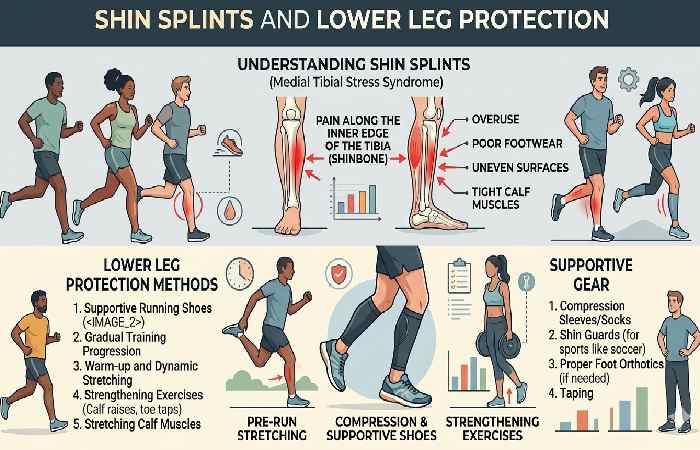
Shin splints (medial tibial stress syndrome) cause pain along the inner edge of the shinbone, often from overuse or poor shock absorption.
How running shoes help:
- Cushioned midsoles reduce the repetitive impact transmitted up the leg
- Stability features prevent excessive pronation that strains the tibia
- Appropriate heel-to-toe drop encourages healthier foot strike patterns
- Lightweight construction minimizes fatigue-related form breakdown
Worn-out shoes with compressed cushioning are a primary cause of shin splints.
Achilles Tendonitis Risk Reduction
Achilles tendonitis—inflammation of the tendon connecting your calf to your heel—can sideline runners for months if not addressed.
How running shoes help:
- Heel cushioning reduces tension on the Achilles attachment point
- Appropriate heel lift (higher heel-to-toe drop) takes stress off the tendon
- Flexibility allows natural tendon lengthening during the gait cycle
- Smooth transitions reduce abrupt loading forces
Runners recovering from Achilles issues often benefit from shoes with an 8-12mm heel-to-toe drop rather than minimalist or zero-drop shoes.
Knee Pain and Patellofemoral Issues
Runner’s knee (patellofemoral pain syndrome) causes pain around or behind the kneecap and is often linked to poor shock absorption or alignment issues.
How running shoes help:
- Cushioning reduces peak impact forces transmitted to the knee joint
- Stability features correct overpronation that can cause knee misalignment
- Proper support maintains neutral leg tracking through the stride
- Adequate midsole thickness prevents excessive loading on knee cartilage
Research indicates that worn-out shoes with degraded cushioning significantly increase knee stress during running.
Stress Fracture Prevention
Stress fractures—tiny cracks in bones caused by repetitive force—are serious injuries requiring extended rest.
How running shoes help:
- Shock absorption reduces peak bone loading with each step
- Proper cushioning distributes force across larger bone surface areas
- Supportive structures prevent excessive motion that concentrates stress
- Adequate replacement ensures consistent protection as shoes age
The 300-500 mile replacement guideline exists primarily to maintain the cushioning and support that prevent stress fractures.
Understanding Running Shoe Features and Their Health Benefits
Cushioning and Shock Absorption
Midsole cushioning is the primary shock-absorbing system in running shoes.
Modern cushioning technologies include:
- EVA foam: Lightweight, responsive, standard in most running shoes
- Polyurethane: Durable, firmer, longer-lasting cushioning
- Proprietary foams: Brand-specific materials (Nike React, Adidas Boost, HOKA EVA)
- Air or gel pockets: Localized high-impact zones for targeted cushioning
Health benefit: Cushioning reduces peak impact forces by 20-30%, significantly lowering stress on bones, joints, and soft tissues.
Important tradeoff: While thicker cushioning reduces peak impact, it also:
- Increases contact time with the ground (higher total impulse)
- Reduces proprioception (foot-ground sensory feedback)
- May increase shoe weight and metabolic cost
The sweet spot: Moderate cushioning that balances protection with ground feel and efficiency.
Arch Support for Different Foot Types
The arch of your foot acts as a natural spring, storing and releasing energy with each step.
How shoe support helps:
- Flat feet: Structured support prevents arch collapse and overpronation
- High arches: Flexible cushioning accommodates natural arch shape and absorbs shock
- Neutral arches: Balanced support maintains natural biomechanics
Health benefit: Proper arch support reduces strain on the plantar fascia, Achilles tendon, and tibialis posterior, preventing inflammation and chronic pain.
Note: While some arch support is beneficial, excessive support can weaken intrinsic foot muscles over time. Finding the right balance is key.
Stability Features and Pronation Control
Pronation—the natural inward roll of the foot after landing—is healthy in moderation. But excessive pronation (overpronation) can lead to:
- Ankle instability
- Knee misalignment
- IT band syndrome
- Increased injury risk
Stability shoes use:
- Medial posts (firmer foam on the inner midsole) to slow pronation
- Wider bases for improved balance
- Supportive heel counters to lock the heel in place
Health benefit: Controlled pronation maintains proper joint alignment and reduces stress on knees and hips.
Heel-to-Toe Drop and Its Impact
Heel-to-toe drop (HTD) measures the height difference between the heel and forefoot, typically ranging from 0mm (minimalist) to 12mm (traditional).
How drop affects health:
- Higher drop (10-12mm):
Reduces stress on Achilles tendon
Encourages heel-strike pattern (common for recreational runners)
May increase knee loading
Wider heel flare can increase ankle rolling risk - Lower drop (0-6mm):
Encourages midfoot/forefoot striking
Reduces knee impact
Strengthens foot and calf muscles
Increases Achilles and calf strain initially
Health benefit: Matching drop to your natural running form and gradually transitioning between different drops reduces injury risk.
Midsole Technology and Energy Return
Modern midsole technologies do more than absorb impact—they return energy.
Carbon fiber plates and responsive foams:
- Improve running economy (reduce oxygen cost by ~3-4%)
- Enhance propulsion with each toe-off
- Reduce muscle fatigue over long distances
Health benefit: Better running economy means your cardiovascular system, muscles, and joints work less hard to maintain the same pace—reducing overall physiological stress.
Tradeoff: Carbon-plated shoes work best at faster paces; at slower speeds, the metabolic cost may actually increase due to added stiffness.
Minimalist vs. Cushioned Running Shoes: Which Is Healthier?
The Case for Cushioned Shoes
Cushioned running shoes remain the most popular choice for good reason.
Health benefits:
- Significantly reduce impact forces on joints
- Protect against stress fractures and bone injuries
- Enable longer runs with less fatigue
- Ideal for heavier runners or those with injury history
- Safer for running on hard surfaces (pavement, concrete)
Research from Harvard Health confirms that cushioned shoes reduce risk of knee and foot pain while providing shock absorption during high-mileage training.
The Case for Minimalist Shoes
Minimalist shoes feature minimal cushioning, lower heel-to-toe drop, and lightweight construction.
Health benefits:
- Strengthen foot muscles: A study in Scientific Reports found that wearing minimalist shoes daily for 6 months improved intrinsic foot muscle strength
- Encourage natural biomechanics and midfoot/forefoot striking
- Improve proprioception (ground awareness) and balance
- May reduce knee loading by promoting forefoot landing
Important caution: Transitioning to minimalist shoes requires gradual adaptation (4-6 months minimum). Abrupt switching can cause calf strain, Achilles issues, and metatarsal stress fractures.
Finding Your Personal Balance
There’s no universal “healthiest” shoe type.
The best approach:
- New runners or injury-prone runners: Start with moderate to high cushioning
- Experienced runners with healthy mechanics: May benefit from rotating between cushioned and minimalist shoes
- Transition gradually: Never make dramatic footwear changes without a 6+ month adaptation period
- Listen to your body: Pain is a signal—adjust accordingly
Many runners find success with a “progressive rotation” strategy: cushioned shoes for long runs and recovery, lighter trainers for tempo work, minimalist shoes for short, easy runs and drills.
The Health Benefits of Shoe Rotation
How Rotating Shoes Reduces Repetitive Stress
Running is the most repetitive athletic motion. Every stride follows nearly identical mechanics—which is why overuse injuries dominate the sport.
Rotating between multiple pairs of shoes introduces subtle variation:
- Different cushioning levels alter impact absorption patterns
- Varying heel-to-toe drops change which muscles activate most
- Diverse midsole firmness prevents localized tissue overload
- Alternating shoe geometry keeps your body “guessing”
Research-backed benefit: Runners who rotate shoes experience fewer overuse injuries because no single tissue structure is stressed identically on every run.
Extending Shoe Life While Protecting Your Body
Here’s a practical rotation strategy:
- Start with Shoe A (new) as your primary trainer
- At ~200 miles, introduce Shoe B (new) and rotate:
- Shoe B for long runs and quality workouts
- Shoe A for easy/recovery runs
- At Shoe A’s ~400-mile mark, retire it and introduce Shoe C
- Continue rotating Shoes B and C
Benefits:
- You never run exclusively in worn-out shoes
- Each shoe lasts longer because it’s used less frequently
- Your body gets variation while maintaining protection
- Total cost may be similar but injury risk is lower
Building an Effective Shoe Rotation Strategy
Sample rotation for different training scenarios:
For beginners (10-20 miles/week):
- 2 pairs of cushioned neutral or stability shoes
- Rotate daily or every other run
Intermediate runners (20-40 miles/week):
- 3 pairs: cushioned long-run shoe, moderate trainer, lighter tempo shoe
- Assign each pair to specific workout types
For high-mileage runners (40+ miles/week):
- 4+ pairs at different wear stages
- Strict rotation prevents any single pair from degrading too quickly
Pro tip: Track mileage on each pair using a running app or shoe tracking journal.
When to Replace Running Shoes for Optimal Health Benefits
The 300-500 Mile Rule Explained
Most running shoes lose significant cushioning and support between 300-500 miles, depending on:
- Your body weight (heavier runners compress foam faster)
- Running surface (concrete wears shoes faster than trails)
- Running form (heel strikers wear heels more quickly)
- Shoe construction quality
Why this matters for health:
After ~400 miles, midsole foam compresses permanently, reducing shock absorption by 20-40%. This increases:
- Impact forces on joints
- Risk of stress fractures
- Likelihood of soft tissue inflammation
Track your mileage and replace shoes proactively—before pain signals that damage has occurred.
Visual Signs Your Shoes Are Worn Out
Check your shoes monthly for these warning signs:
- Compressed midsole: Press the midsole—if it doesn’t bounce back, cushioning is dead
- Uneven tread wear: Worn patches indicate alignment issues
- Heel counter breakdown: Squeeze the heel—if it collapses easily, stability is compromised
- Creasing or cracking: Visible damage to upper or midsole
- Persistent pain: New aches that coincide with higher shoe mileage
If you notice multiple signs, replace immediately—even if mileage is below 300 miles.
How Worn Shoes Compromise Your Health
Running in worn-out shoes increases injury risk by up to 40%.
Degraded footwear causes:
- Increased impact forces that stress bones and joints
- Loss of stability leading to ankle rolls and alignment issues
- Reduced energy return causing premature fatigue and form breakdown
- Exacerbated biomechanical flaws that were previously compensated for
Bottom line: Retiring shoes on time is injury prevention insurance.
How to Choose the Right Running Shoes for Your Health Needs
Determining Your Foot Type and Arch
The “wet test” provides a quick assessment:
- Wet the bottom of your foot
- Step on a paper bag or dark paper
- Examine your footprint:
- Flat arch: Full foot impression visible
- Neutral arch: Moderate curve on inner edge
- High arch: Narrow connection between heel and forefoot
Match your arch type to appropriate shoe categories (stability for flat feet, neutral cushioned for normal arches, cushioned flexible for high arches).
The Importance of Professional Gait Analysis
Gait analysis identifies your specific biomechanical patterns:
- How your foot strikes the ground (heel, midfoot, forefoot)
- Degree of pronation or supination
- Stride length and cadence
- Areas of excessive pressure or instability
Where to get analyzed:
- Running specialty stores (often free)
- Sports medicine clinics
- Podiatry practices
Investment value: A 10-minute gait analysis can prevent months of injury by identifying the exact shoe features you need.
Finding the Right Fit and Size
Proper fit is as important as shoe type.
Sizing guidelines:
- Thumb-width space (½ inch) between longest toe and shoe end
- Snug heel that doesn’t slip
- Comfortable midfoot without pinching
- Room for toe splay in the toe box
Try shoes:
- Late afternoon/evening when feet are slightly swollen (mimics running conditions)
- With your running socks
- On both feet (most people have slightly different sizes)
- By running in-store on a treadmill if possible
Testing Shoes Before Committing
Many running stores and brands offer:
- 30-60 day trial periods with full refund options
- In-store treadmill testing
- “Demo” programs where you test multiple shoes
Test protocol:
- Run at least 2-3 times in new shoes before committing
- Monitor for any new pain or discomfort
- Assess comfort, stability, and confidence during runs
If shoes cause pain within the first 50 miles, they’re not right for you—return or exchange them immediately.
Common Myths About Running Shoes and Health
“More Cushioning Always Equals Better Protection”
Truth: While cushioning reduces peak impact, excessive cushioning creates tradeoffs:
- Reduces proprioception and ground feel
- May increase contact time (higher total impulse)
- Can weaken foot muscles if used exclusively
- Adds weight that increases metabolic cost
The evidence: A comprehensive Cochrane review found no definitive proof that heavily cushioned shoes reduce injury rates more than moderate cushioning.
Takeaway: Moderate cushioning balanced with some ground feel may be healthier than maximal cushioning for many runners.
“Expensive Shoes Are Always Healthier”
Truth: Price doesn’t guarantee health benefits.
What matters:
- Proper fit for your foot shape
- Appropriate support for your biomechanics
- Quality construction that lasts 300+ miles
- Comfort during actual running
**A 250 premium model that causes blisters or pain.
Focus on features and fit, not price tag.
“One Shoe Type Works for Everyone”
Truth: Running shoes should be individually matched to:
- Foot type and arch structure
- Running form and strike pattern
- Body weight and injury history
- Training volume and intensity
- Running surface (road, trail, track)
Universal “best shoe” lists are misleading. What works for a 140-pound forefoot striker won’t work for a 200-pound heel striker with flat feet.
Get personalized: Invest in gait analysis and expert fitting.
Conclusion: Investing in Your Running Health
The health benefits of proper running shoes extend far beyond comfort. They are your body’s primary defense system against the cumulative stress of thousands of footstrikes, protecting your joints, preventing injuries, and enabling the consistency that unlocks running’s full health potential.
FAQ SECTION
- What are the main health benefits of running shoes?
Running shoes provide injury prevention, joint protection, improved biomechanics, reduced fatigue, and long-term musculoskeletal health. They absorb shock forces that would otherwise damage bones, joints, and soft tissues, while supporting proper foot alignment and efficient running form.
- How do running shoes prevent injuries?
Running shoes prevent injuries through cushioned midsoles that absorb impact, supportive structures that maintain foot alignment, stability features that control excessive pronation, and proper fit that prevents friction and excessive motion inside the shoe. They protect against common injuries like plantar fasciitis, shin splints, and knee pain.
- How often should I replace running shoes to maintain health benefits?
Replace running shoes every 300-500 miles, or approximately every 4-6 months for regular runners. Worn-out shoes lose cushioning and support, significantly increasing injury risk. Track your mileage and replace shoes proactively—before pain signals that damage has occurred.
- Are cushioned or minimalist running shoes healthier?
Neither is universally healthier—it depends on your biomechanics, experience level, and goals. Cushioned shoes offer better impact protection and are ideal for beginners, heavier runners, or those with injury history. Minimalist shoes can strengthen foot muscles and improve proprioception but require a 6+ month gradual transition to avoid injury. Many runners benefit from rotating both types.
- Can running shoes protect my knees and joints from damage?
Yes. Proper running shoes reduce peak impact forces by 20-30%, protecting knee cartilage, ankle ligaments, and hip joints from repetitive stress. Research shows that cushioned shoes decrease loading rates and maintain joint health over time, especially when replaced regularly before cushioning degrades.