






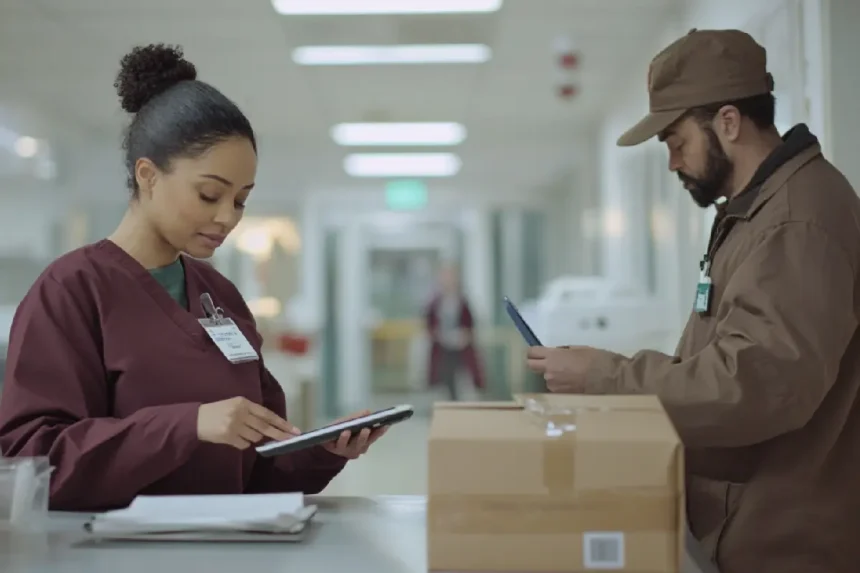
Healthcare facilities depend on reliable internal logistics. Packages arriving at a hospital, clinic, or medical campus may contain administrative supplies, replacement equipment, documents, uniforms, technology, or other items needed by departments throughout the organization.
Once a courier completes a delivery, responsibility often shifts to an internal mailroom or receiving team. That creates an important security challenge: facilities need to maintain visibility and accountability while packages move from the receiving point to the correct department or authorized recipient.
A structured approach supported by mobile-friendly mailroom management can strengthen this process through digital registration, package tracking, automated notifications, searchable records, and documented collections. Technology cannot eliminate every handling risk, but it can reduce the information gaps that make packages difficult to trace.
Table of Contents
Mailroom Security Begins at Receiving
Security starts when an item enters the facility.
In a manual environment, employees might accept a package and record limited information in a paper log or spreadsheet. If several deliveries arrive simultaneously, inconsistent registration can make later investigation difficult.
A standardized digital receiving process creates a stronger foundation.
Mailroom employees should register relevant package information in accordance with facility procedures and associate each item with the appropriate recipient or department. Deliveries that cannot be identified should follow a defined exception process rather than entering normal distribution.
This establishes an initial record and makes it easier for authorized employees to determine whether an item was actually received internally.
Secure package handling depends on maintaining accountability at each internal handoff, not simply recording that a courier reached the building.
Create Visibility Between Arrival and Collection
A courier’s tracking system generally provides visibility up to the delivery point. Healthcare facilities may still need to move the package through several internal stages.
An item could pass from central receiving to temporary storage, an internal distribution route, a departmental office, or a designated collection point.
Without internal tracking, these movements can create blind spots.
Digital package tracking can maintain a clearer record of the parcel’s progress within the facility. When staff follow consistent procedures for recording relevant movements and handoffs, employees investigating an item have more information than a simple external delivery confirmation.
This is particularly useful in large healthcare environments with multiple buildings, departments, and receiving areas.
Control Access to Package Storage Areas
Physical security remains essential even when digital tracking is available.
Packages waiting for internal distribution or collection should be stored according to the healthcare organization’s security policies. Storage areas should not function as uncontrolled spaces where anyone passing through can remove an item.
Access should be appropriate to employees’ responsibilities.
Facilities should also maintain an orderly storage system so authorized staff can locate packages without unnecessary searching. Digital records and physical organization need to correspond. If a system indicates one storage location while the parcel is physically somewhere else, the security and operational value of the record is reduced.
A secure mailroom therefore combines controlled physical handling with accurate digital information.
Strengthen Accountability at Handoffs
Every handoff introduces an opportunity for uncertainty.
A parcel may move from a courier to receiving staff, from receiving to an internal delivery employee, and finally to a department or recipient. If these transitions are informal, determining responsibility later can become difficult.
The difference between loosely managed and structured handling is significant:
| Package Stage | Informal Process | Security-Focused Process |
| Receiving | Basic manual entry | Structured digital registration |
| Identification | Staff interpret label individually | Recipient or department verified |
| Storage | Package placed where space is available | Defined, controlled storage process |
| Notification | Manual message or phone call | Automated notification where appropriate |
| Internal transfer | Limited documentation | Relevant handoff recorded |
| Collection | Informal pickup | Collection event documented |
| Investigation | Search logs and ask staff | Review searchable package history |
Documented handoffs do not guarantee that problems will never occur. They provide a clearer trail when employees need to investigate what happened.
Use Notifications Without Exposing Unnecessary Information
Recipient notifications can improve both efficiency and package security.
If employees manually contact every department or recipient, communication can become delayed during busy periods. Packages may remain in storage longer than necessary.
Automated notifications can inform recipients after deliveries have been registered and are ready for the next stage of the facility’s process.
Healthcare organizations should still be thoughtful about the information included in those communications. Package notifications should contain only the operational details necessary for collection or handling.
A mailroom does not need to create unnecessary records about the contents of ordinary deliveries. Data collection should remain appropriate to the operational purpose and the organization’s policies.
Establish Procedures for Unidentified and Suspicious Items
Not every package should move immediately into the standard workflow.
Deliveries can arrive with incomplete addresses, unknown recipients, damaged packaging, or other irregularities. Employees need clear instructions for what to do when an item cannot be processed normally.
Mailroom teams should know when to separate an item from routine handling and when to involve the appropriate internal personnel in accordance with established facility procedures.
Staff should not be expected to make specialized security judgments without training.
The important operational principle is exception control. When something does not meet standard receiving requirements, employees need a defined alternative process rather than improvising.
Searchable Records Make Investigations More Efficient
When a package cannot be located, fragmented records can turn the search into a lengthy process.
Employees may need to check spreadsheets, search emails, contact colleagues, and inspect several storage locations. Shift changes can make the investigation harder because the employee who originally handled the item may no longer be available.
Searchable digital records provide a common information source.
Authorized staff can review whether a package was registered, which recipient or department was associated with it, and what subsequent events were recorded.
This reduces dependence on individual memory and helps security, operations, and mailroom teams investigate using the same available information.
Train Employees in Secure Digital Mailroom Practices
Technology improves accountability only when employees use it consistently.
Healthcare mailroom training should cover digital registration, package tracking, automated notifications, searchable records, collection tracking, and the procedures required for internal handoffs.
Physical security should be integrated into the same training.
Employees need to understand storage requirements, access rules, recipient verification procedures, and how to respond when a delivery does not match the normal workflow. They should also understand what information belongs in mailroom records and who is permitted to access it.
Training should emphasize the connection between physical actions and digital records. Moving a package without completing the corresponding workflow can create the same visibility problems as inaccurate data entry.
Review Package Processes as Facilities Change
Mailroom security is not a one-time project.
Healthcare facilities change departments, renovate buildings, introduce new receiving locations, modify staffing patterns, and adopt new technology. Package procedures need to remain aligned with those changes.
Digital records can help operations teams identify recurring exceptions, collection backlogs, or areas where internal handling repeatedly becomes difficult.
Managers can combine this information with employee feedback and direct observation to determine whether procedures, storage arrangements, training, or workflows need adjustment.
Automation can reduce repetitive administrative work, but employees remain central to identifying weaknesses and resolving unusual situations.
Building a More Accountable Healthcare Mailroom
Improving healthcare mailroom security does not depend on a single technology or control. It requires a consistent process from receiving through final handoff.
Digital registration establishes an initial record. Package tracking improves visibility during internal movement. Controlled storage protects items awaiting distribution, while notifications and collection records support timely, accountable handoffs. Searchable histories provide useful information when something needs to be investigated.
These digital capabilities work best when paired with trained employees, appropriate access controls, organized physical storage, and clear procedures for exceptions.
By connecting physical package handling with accurate digital records, healthcare facilities can create mailroom operations that are easier to manage, more accountable, and better prepared to support secure internal distribution.